Who is actually playing?
An organ is sounding, but nobody is sitting at the console. At the Konzerthaus Berlin, a computer can now control the large Jehmlich organ directly. But why would anyone want it to?
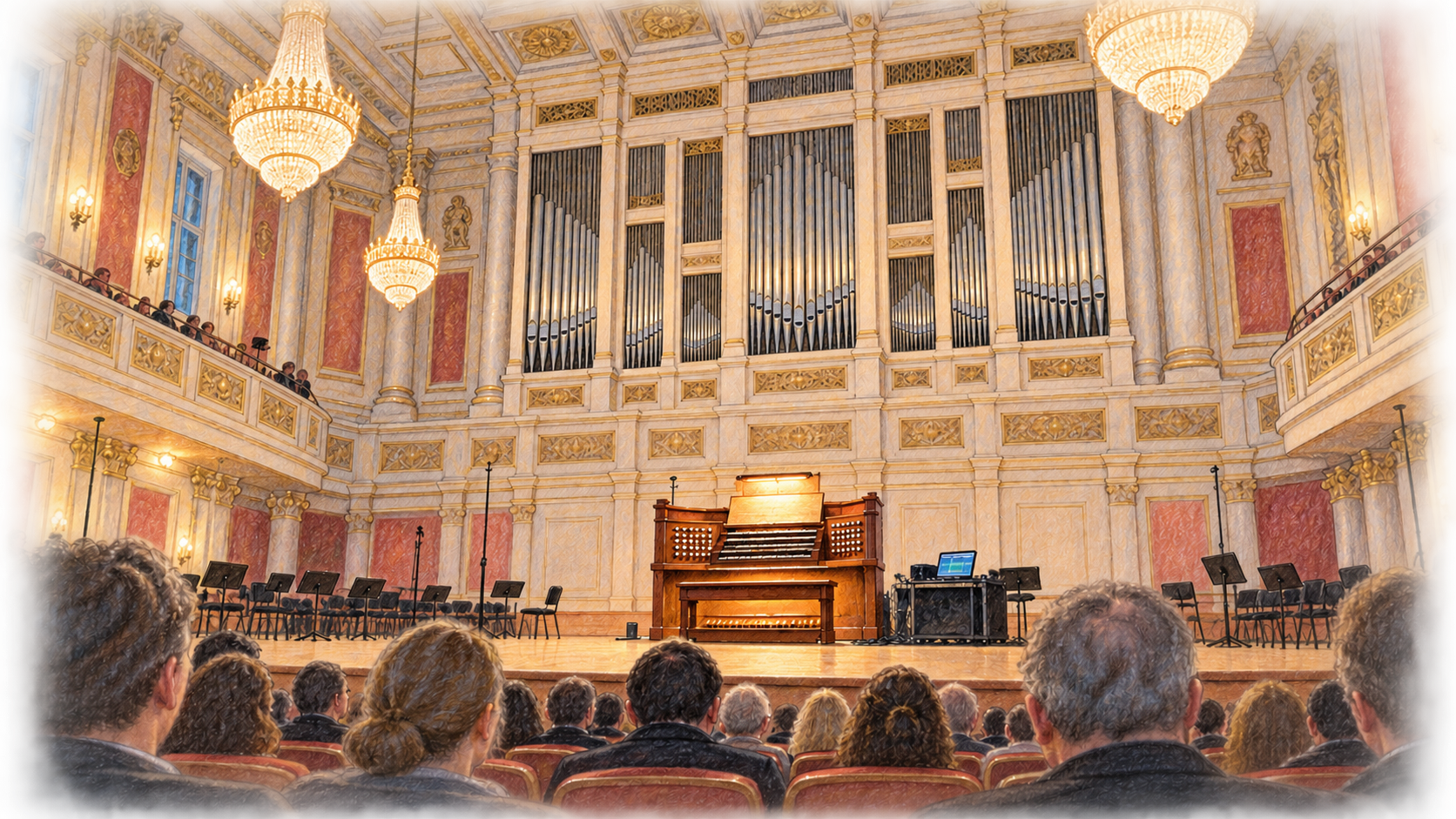
You are sitting in a concert hall listening to an organ. Air flows through the pipes and the whole room begins to resonate. Only one thing seems to be missing from this organ concert: someone playing the organ.
On Wednesday, 30 September, the AGGREGATE Festival for automated and contemporary organ music begins at the Konzerthaus Berlin. Its opening concert is called pipes & circuits. For the occasion, the large Jehmlich organ in the Great Hall has been technically expanded. For the first time, it can be controlled directly by a computer.
That may sound like electronic music. But this is precisely what makes it interesting: the computer is not producing an artificial organ sound to be played through loudspeakers. The real organ is playing.
A computer without fingers
An organist presses keys and pedals and selects stops. A computer has neither hands nor feet. But it can send instructions to the organ: play this note now. Hold it. Now play the next one.
The technical connection used for this is called MIDI. You do not need to remember the term. What matters is what happens at the other end: the organ's control system translates the digital instructions, valves release air to the appropriate pipes, and a perfectly real acoustic organ tone fills the hall.
The Konzerthaus therefore calls the converted instrument a hyperorgan. Its thousands of pipes have not suddenly become loudspeakers. What is new is the ability of a computer to tell them when to sound. The opening concert makes this especially clear: two sections from Laurie Spiegel's electronic work The Expanding Universe will be performed on the great organ – without loudspeakers.
Why do it at all?
That may be the more interesting question. Organists already exist, after all. So why let a machine play?
Because a computer does not have ten fingers and two feet – and is therefore not limited by them either. Composers can organise sequences, repetitions and simultaneous processes differently when no human body has to perform every action directly.
Those are exactly the possibilities the festival wants to explore. The Berlin duo gamut inc, Marion Wörle and Maciej Śledziecki, founded AGGREGATE and curate the festival. They have worked with automated musical instruments for years and are ensemble in residence in the Konzerthaus organ series this season.
Different approaches meet on Wednesday. Seth Horvitz, aka Rrose, gives the premiere of studies for automated pipe organ. Music by Phillip Sollmann and Konrad Sprenger is adapted for the Konzerthaus organ. And gamut inc brings the great Jehmlich organ into dialogue with BLACK SQUARE, wind-dynamic modular organs developed especially for the duo.
The question “Can a computer play an organ?” then turns into a musical one: what can be played this way that perhaps could not be played before?
An old machine gets a new player
Machines and organs are not complete strangers anyway. A pipe organ is itself an enormous technical construction. For centuries, mechanics and moving air have transformed human movements into music. Now there is a new way of addressing that machine.
Technological change has repeatedly fascinated and unsettled people at the same time. In the nineteenth century, steam power and railways changed not only what machines could do but also the pace of work, travel and everyday life. With digital technologies today, once again it is not only what has become possible that surprises us, but how quickly the possibilities are changing.
That encounter can actually be heard at the Konzerthaus on Wednesday: on one side, pipes, wind and an instrument based on a centuries-old principle; on the other, digital instructions arriving in fractions of a second.
Who makes the music?
One boundary remains fairly clear on Wednesday. The computer has not decided to give a concert. People composed, adapted and programmed the music. The computer transmits playing instructions. The organ turns them into moving air and sound. And in the end, people listen.
The AGGREGATE opening concert begins on Wednesday, 30 September, at 8 pm in the Great Hall of the Konzerthaus Berlin. The programme includes Laurie Spiegel, Rrose, Sollmann/Sprenger and gamut inc, and the concert is scheduled to run, with an interval, until about 10.30 pm.
But the new connection between computer and organ leaves one question open. Today, people decide which music the computer sends to the organ. One day, artificial intelligence could take over that first step too and have its own music played immediately by real organ pipes.
Who would be composing then? Who would be playing? And would the result still be organ music?