What does a self-portrait sound like?
Smetana can make a river appear in our imagination through music. In Tallinn, the TubIN Festival asks a harder question: can music also reveal something of a person?
You do not need a map to travel with Smetana’s Vltava. The music creates a river: small at first, then broader, moving past landscapes and people. Of course no real water flows through the concert hall. The picture forms in your mind. Music can show us something even when there is nothing to see.
But can it do the same with a person?
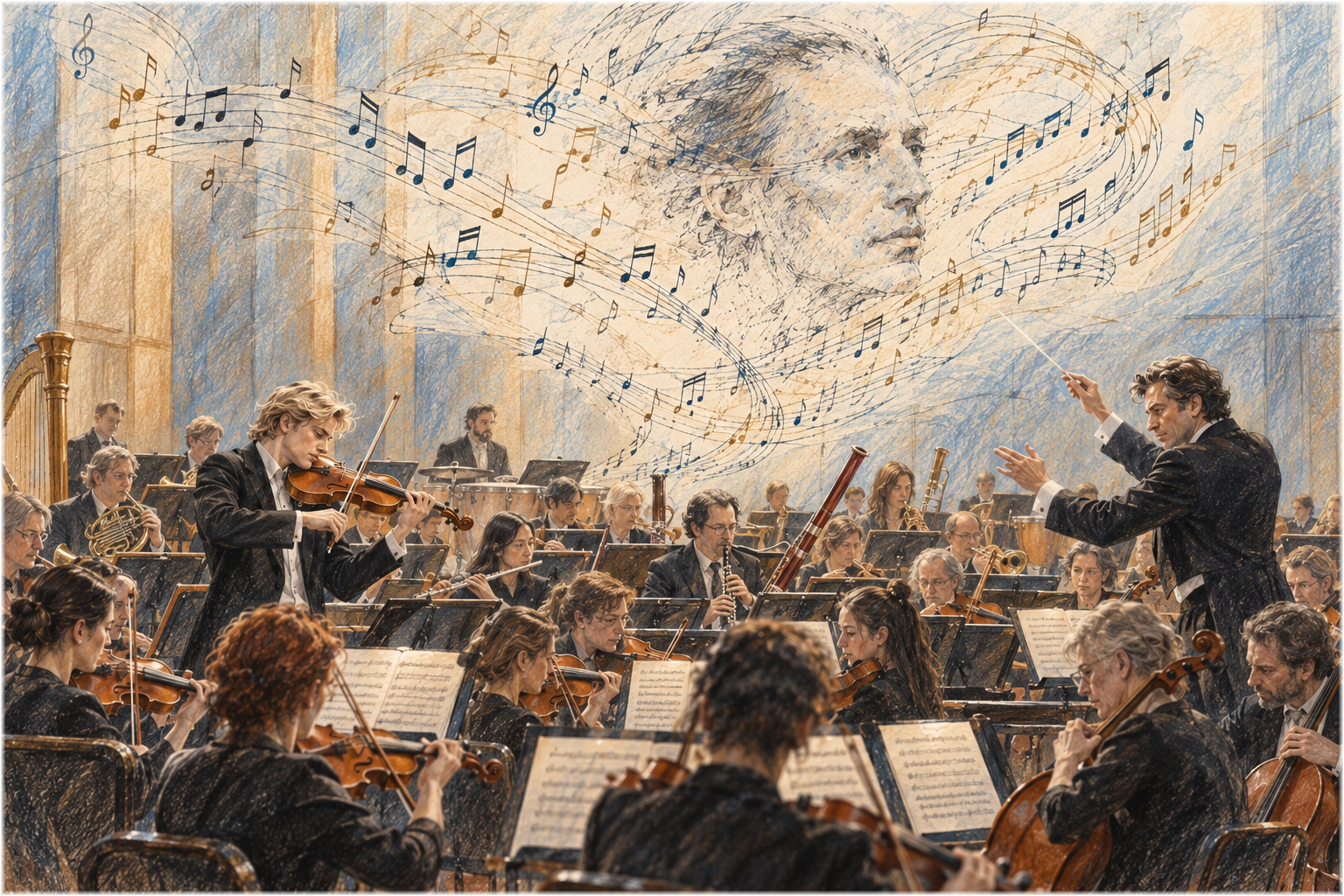
On Friday, 2 October, a concert at Estonia’s TubIN Festival in Tallinn is called “Minapilt” – “Self-Portrait”. The Estonian National Symphony Orchestra, conducted by Mihhail Gerts, will perform three works by Eduard Tubin. Together, they are meant to reveal different sides of the composer. But how do you paint a self-portrait without a brush?
What can music show us about a person?
A painted self-portrait can tell us a great deal. What is the person wearing? Where are they looking? What is behind them? Which colours have they chosen? Even the decision about what not to show can tell us something.
Music cannot do any of that literally. It cannot show us Tubin’s eye colour or the way he sat while composing. A composer makes different choices instead: Which melodies return? Which sounds are connected with home? When does the music become quiet, restless or almost exuberant? Perhaps a musical self-portrait is built not from physical resemblance but from selection.
The Tallinn programme places three very different works next to one another: the Sinfonietta on Estonian Motifs, the Second Violin Concerto and Symphony No. 5. The festival describes the Sinfonietta as a luminous soundscape in which reflection alternates with the playful spirit of a village celebration. It also reveals something of the youthful, pastoral character that formed part of Tubin’s artistic identity.
That is rather different from a passport photograph.
Can you hear where someone comes from?
Eduard Tubin was born in Estonia in 1905, studied in Tartu and worked there as a conductor, choir director and composer. In 1944 he left Estonia for Sweden, where he spent the rest of his life.
It would be easy to turn that immediately into a story about exile and lost homeland. But another question may be more interesting for this concert: what remains of a place inside a person after that person has long been living somewhere else?
You can genuinely listen for that question in Tubin’s Fifth Symphony. It was his first symphony written in exile. Two Estonian melodies appear in it: Meil aiaäärne tänavas and the chorale Öö lõpeb tääl. According to the festival, this is the only occasion in his symphonic cycle on which Tubin turned so directly to this kind of inherited musical material. The organisers therefore describe the Fifth as one of his most personal works.
Perhaps memory works differently in music than it does in a photo album. A photograph shows what a place once looked like. A melody can remain part of how someone thinks and feels decades later. In that sense, a person’s origins would not be the background of the self-portrait. They would be part of the person.
One voice in front of the orchestra
Between the Sinfonietta and the symphony comes Tubin’s Second Violin Concerto from 1945, with Hans Christian Aavik as soloist. The festival describes the work as dramatic and connects its intensity with that of the Fifth Symphony, composed soon afterwards.
A violin concerto gives us another way to think about a self-portrait. Suddenly, in front of an entire orchestra, there is one individual voice. It can join the others, push against them, disappear and emerge again.
Of course we should not simply turn that into biography in sound. The solo violin is not automatically “Tubin”, and a particular melody cannot reliably be translated into a particular thought. But perhaps a self-portrait does not need to be a puzzle we can completely solve. When someone paints themselves, we do not know the reason behind every brushstroke either.
Three works, one person?
That is precisely what makes the programme intriguing. None of the three works has to explain “Eduard Tubin” on its own. The contrasts only emerge when we hear them side by side: a Sinfonietta with Estonian motifs and rural exuberance; the individual, dramatic voice of the violin; and finally a symphony in which melodies from Estonia cross years and borders before appearing inside a new composition.
Perhaps that resembles a self-portrait more closely than a single image ever could. People are not always the same either. Someone can be shaped by childhood, live somewhere else, begin something new and still carry old melodies within them.
That is why the 2026 TubIN Festival asks the broader question “Who am I?” Artistic director Mihhail Gerts invites listeners to search Tubin’s music for elements of the composer’s own self-image – and perhaps elements of their own. At that point, the question stops belonging only to Eduard Tubin and begins to address everyone listening.
What would you sound like?
Imagine making a self-portrait. You may not use a photograph, draw anything or write a single word. You are allowed only sounds.
Which three would have to be there? Perhaps a sound from the place where you grew up. A song someone in your family always listened to. An instrument. A language. A railway station. Rain against a window. Voices in a school playground. Or something that sounds completely insignificant to everyone else but belongs unmistakably to you.
Nobody might recognise your face from those sounds. But they might recognise something else: not what you look like, but something of who you are.
On Friday, 2 October at 7 pm, the Estonian National Symphony Orchestra, violinist Hans Christian Aavik and conductor Mihhail Gerts will perform Tubin’s Sinfonietta on Estonian Motifs, his Second Violin Concerto and Symphony No. 5 at the Estonia Concert Hall in Tallinn. With an interval, the concert is scheduled to finish at about 9.15 pm.
Smetana can make a river appear before our inner eye through music. On Friday in Tallinn, listeners can find out whether music can do something else as well:
let us hear something of a person’s soul.