What does independence sound like? Lviv connects memory with new Ukrainian folk
On 24 August, Ukraine marks 35 years of independence. In Lviv, two very different music projects explore what cultural self-determination can mean: one looks back at suppressed history, while the other allows old songs to live on in a new sound.
Independence can be told through dates.
On 24 August 1991, the Ukrainian parliament declared Ukraine independent. Thirty-five years later, Lviv marks the date with concerts, exhibitions, markets and events across the city.
But perhaps independence can also be heard.
Yesterday, 23 August, an event at the Memorial Museum of Totalitarian Regimes “Territory of Terror” began with exactly that idea. Its title is: “This is what independence sounds like”.
The project was created together with the Lviv National Philharmonic. The Virtuosi Lviv chamber orchestra performed Ukrainian music in a place whose exhibitions tell of persecution, occupation and totalitarian rule. The official programme describes Ukrainian music as part of European culture that repeatedly came under pressure from different totalitarian regimes during the twentieth century. With state independence came the return of the right to determine one's own cultural memory.
Music moves through spaces
The concert did not simply remain on one stage.
Visitors moved through different rooms of the museum: a Lviv apartment from before the Second World War, an apartment from the Soviet era, the exhibition about Olenivka and finally an outdoor area containing Soviet monuments.
The same question therefore acquired a different background each time: what happens to music and cultural memory when political systems seek to determine what may be publicly seen and heard?
The past does not remain closed behind a museum door.
Because this evening the same question will be asked again in a completely different place.
Old songs acquire a new sound
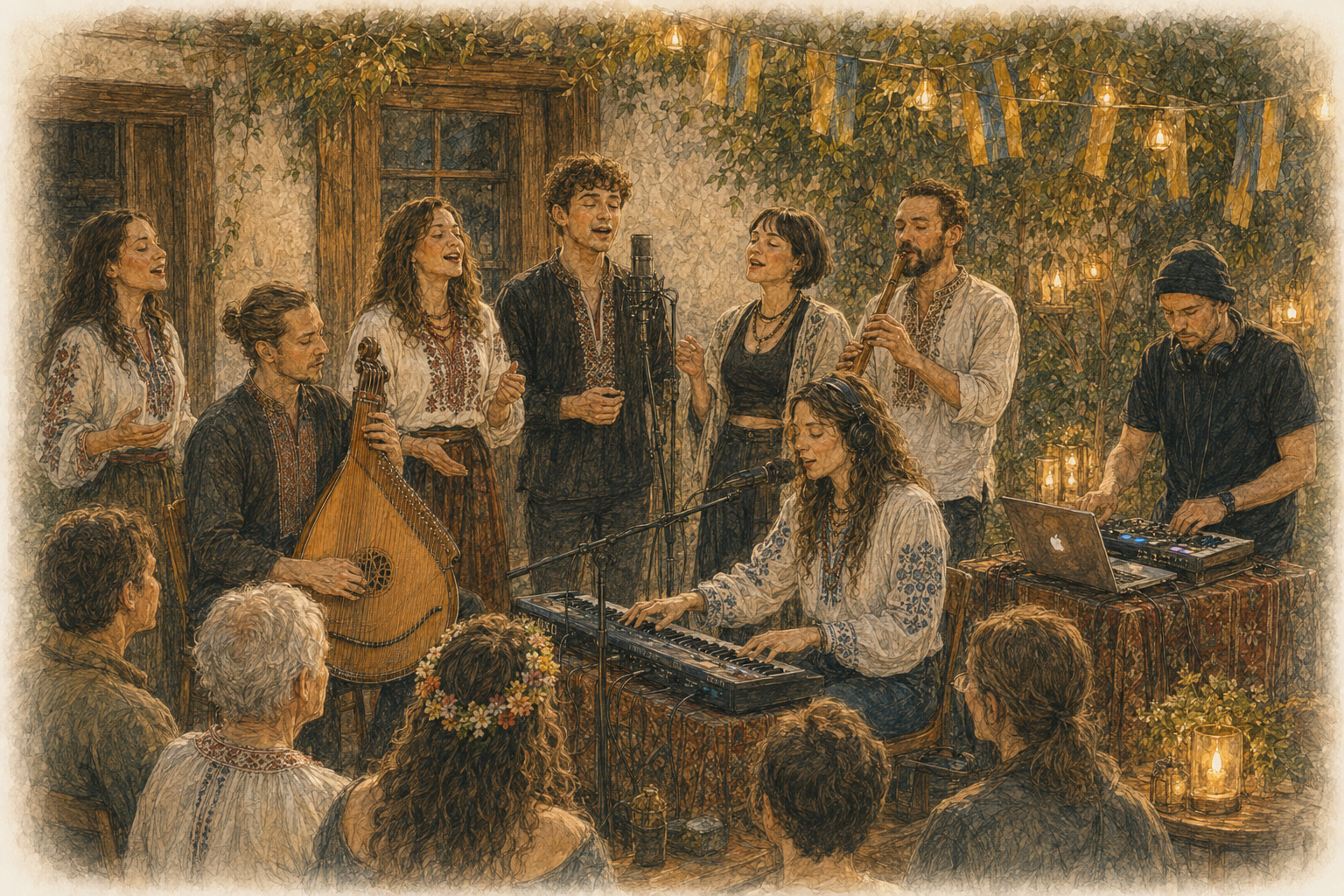
At Shevchenkivskyi Hai, Lviv's open-air museum, the ethno group Eteria will perform. The ensemble works with Ukrainian vocal tradition and collects and documents rare Ukrainian folk songs and melodies.
One might expect an evening like this to try to preserve a historical sound as faithfully as possible.
Today Eteria is doing something different.
Alongside songs in the group's established style, pieces in experimental electronic dance arrangements are scheduled to be heard for the first time. The official programme describes the evening as a meeting between old tradition and modern music. At 7 p.m. there will first be a live set by NevertheLes, the electronic project of Les Yakymchuk. Eteria performs at 8 p.m.
That turns preservation into something more interesting.
A folk song does not remain alive because nobody is allowed to change it. It can also survive because a new generation decides to make something of its own from it.
Tradition is not a still image
Eteria also releases recordings of traditional songs outside this concert. The group sees its work as collecting, recording and passing on rare Ukrainian songs and melodies.
That is where the two Lviv events of this weekend meet, even though they look completely different.
Yesterday, music moved through rooms in which history and repression become visible.
Today, old melodies move into electronic arrangements.
One asks what had to be preserved.
The other shows what can grow from it.
The event at Shevchenkivskyi Hai also recalls the circumstances in which Independence Day is being marked in 2026. During the evening, donations for tactical medicine will be collected together with UA FirstAid.
Perhaps cultural independence therefore does not mean keeping the past as unchanged as possible.
It also means being able to decide which stories to remember, which songs to sing – and how they should sound tomorrow.
Today, 24 August, Lviv offers two answers: memory needs a voice. Tradition is allowed to change.