When it’s gone, where does it go?
What disappears down the drain has not necessarily disappeared. At the R.o.R+ festival in Brda, art and science follow the journey of microplastics through water.
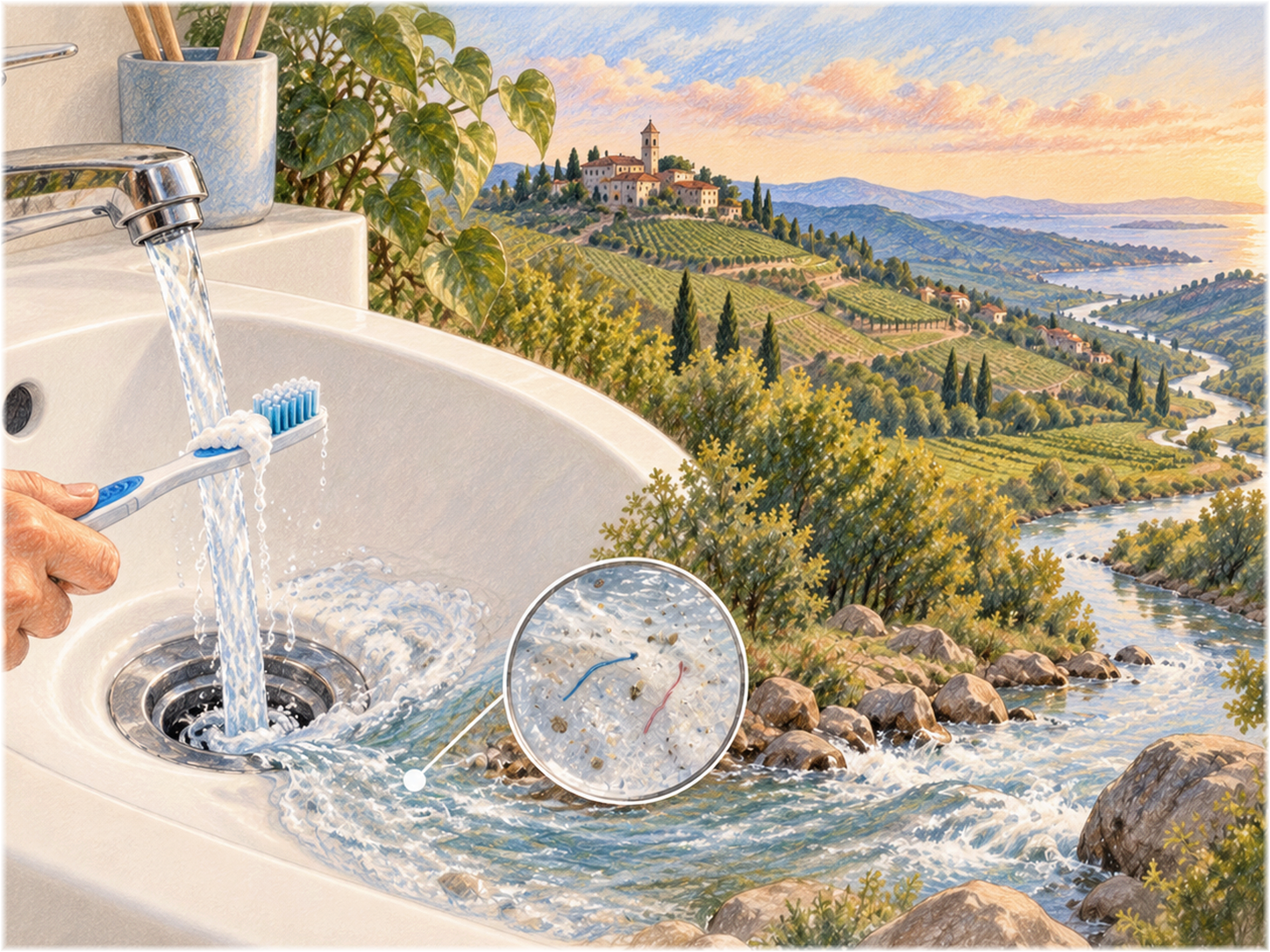
You brush your teeth, rinse your mouth and let the tap run. Foam, water, toothpaste – everything disappears down the drain. Gone. But where has it actually gone?
That simple question can lead surprisingly far: to treatment plants, rivers and seas, to pieces of plastic too small for us to notice with the naked eye, and eventually to the question of what may find its way back into our surroundings.
In Slovenia’s Brda region, the R.o.R+ – Blue Drift: What Flows Through Us festival turns that question into both art and science. From 1 to 4 October, Vila Vipolže hosts works and events about water, microplastics and a boundary that is far less obvious than it first appears: where does the environment end and where do we begin?
Plastic on purpose
Microplastics can form when larger plastic objects break down or materials wear away. Tyres and synthetic textiles are among their sources. But some tiny plastic particles have also been manufactured deliberately and added to products.
Some toothpastes once contained tiny pieces of plastic, often polyethylene. They were used as abrasive or polishing agents. In other words, they had a clear purpose inside the product – and after brushing, they were simply rinsed away.
Looking back, that is the strange part: they had only disappeared from the sink.
The European Union now restricts intentionally added microplastics in many products. Microbeads used for cleaning, polishing or exfoliating have not been allowed onto the market since October 2023.
That leads to an uncomfortable question: when is an invention actually a good invention? When it solves the problem it was designed to solve? Or only when we have also considered what happens to it after we use it?
The drain is not the end
We can still recognise a plastic bottle as a bottle and a bag as a bag. But as plastic breaks into smaller and smaller pieces, the object may disappear from view while the material itself remains.
Microplastics can travel with water, settle in sediments or be taken up by organisms. That constant movement is captured in the name Blue Drift. The festival therefore connects its theme to a real waterscape: the Soča, Vipava and Tagliamento rivers, smaller local waterways and the Adriatic Sea.
Water does not care about the borders we draw on maps between countries and regions. Tiny particles do not either. Something that enters the water in one place can continue its journey somewhere else. In that sense, “gone” often means only that we can no longer see it.
How do you look for something you can barely see?
On Friday and Saturday, that question becomes practical in Vipolže. On 2 October, GLOBE Italia will use a pop-up laboratory to show visitors how water is sampled for microplastics and how tiny plastic particles are monitored in aquatic environments. On 3 October, Slovenia’s Institute for Water will join the programme as well.
That is one of the fundamental jobs of environmental research: making something visible or measurable that might otherwise go unnoticed. A glass of water can look perfectly clean and still contain substances we cannot recognise without the right tools.
This is where art enters the story.
When plastic appears on your own image
In Plastic Bloom by the duo Lumoskop_lab, structures derived from real microplastic samples are projected across or combined with the visitor’s image. Suddenly, the body and the plastic particle occupy the same visual space.
Damijan Šporčić takes a different approach. In Fish Food. Back on the Menu, he works with plastic collected from beaches in the Kvarner region. Even the title reverses the direction of our thinking: something we throw away can continue moving through an ecosystem.
That does not mean every particle washed down a drain automatically travels through a fish and ends up on our plate. The pathways are far more complicated. Microplastics have, however, been detected in marine and fresh water, food, drinking water and air, so people can encounter them through several routes. The long-term health effects of that exposure are still not fully understood.
There is no need to turn that uncertainty into a horror story. A more interesting conclusion is this: the boundary between “the environment” and “us” is apparently not watertight.
An invention has an afterlife
Perhaps that means we should ask different questions when we invent something. Not only: does it work? Is it useful to us? But also: what happens to it afterwards?
A good invention should not merely solve a human problem. As far as possible, it should avoid creating a new one somewhere else.
The immediate purpose of plastic particles in toothpaste was easy to understand: they were meant to clean or polish. The problem began almost exactly where the instructions for using the product ended – at the drain.
We know that example now. With new materials, products and technologies, however, we often do not know which question will seem obvious when people look back twenty or fifty years from now. Perhaps we need to become better not only at inventing new solutions, but also at imagining the whole journey of an invention.
What flows through us?
The R.o.R+ festival opens on Thursday, 1 October at 7.30 pm at Vila Vipolže in Brda. The exhibition is open during the evenings from 2 to 4 October. The announced microplastics laboratories begin at 6.30 pm on Friday and Saturday.
At first, the festival title What Flows Through Us sounds almost philosophical. After a while it becomes remarkably concrete: water flows, substances move with it, and some things we thought had disappeared simply continue their journey.
Which leaves one very small question:
When it’s gone, where does it go?