Vienna: A District Invites You In
FAVORITE FALL turns Vienna’s 10th district into a stage. Residents, augmented-reality walks and neighbourhood tours invite visitors to discover Favoriten — a Vienna beyond the familiar sights.
St Stephen’s Cathedral, the Hofburg and City Hall, Schönbrunn Palace and the Prater with its famous Ferris wheel all seem to be queuing up to be visited. If you have a few days, you might also head out to the Danube Island, enjoy the view across the water from the Reichsbrücke and spot the distinctive towers of the UN complex beyond. So it is perfectly possible to have seen quite a lot of Vienna and still almost miss one of its largest districts.
Just south of the main railway station begins Favoriten, Vienna’s 10th district. From 21 to 27 September, it becomes the stage for the cultural festival FAVORITE FALL. More than 60 events are spread across the district, including concerts, exhibitions, readings, theatre, discussions, walks and art in public space. Many are free, and 2026 marks the festival’s third edition. But the idea can be put much more simply: residents invite people to get to know their district and see it through their eyes.
A Vienna beyond the famous sights
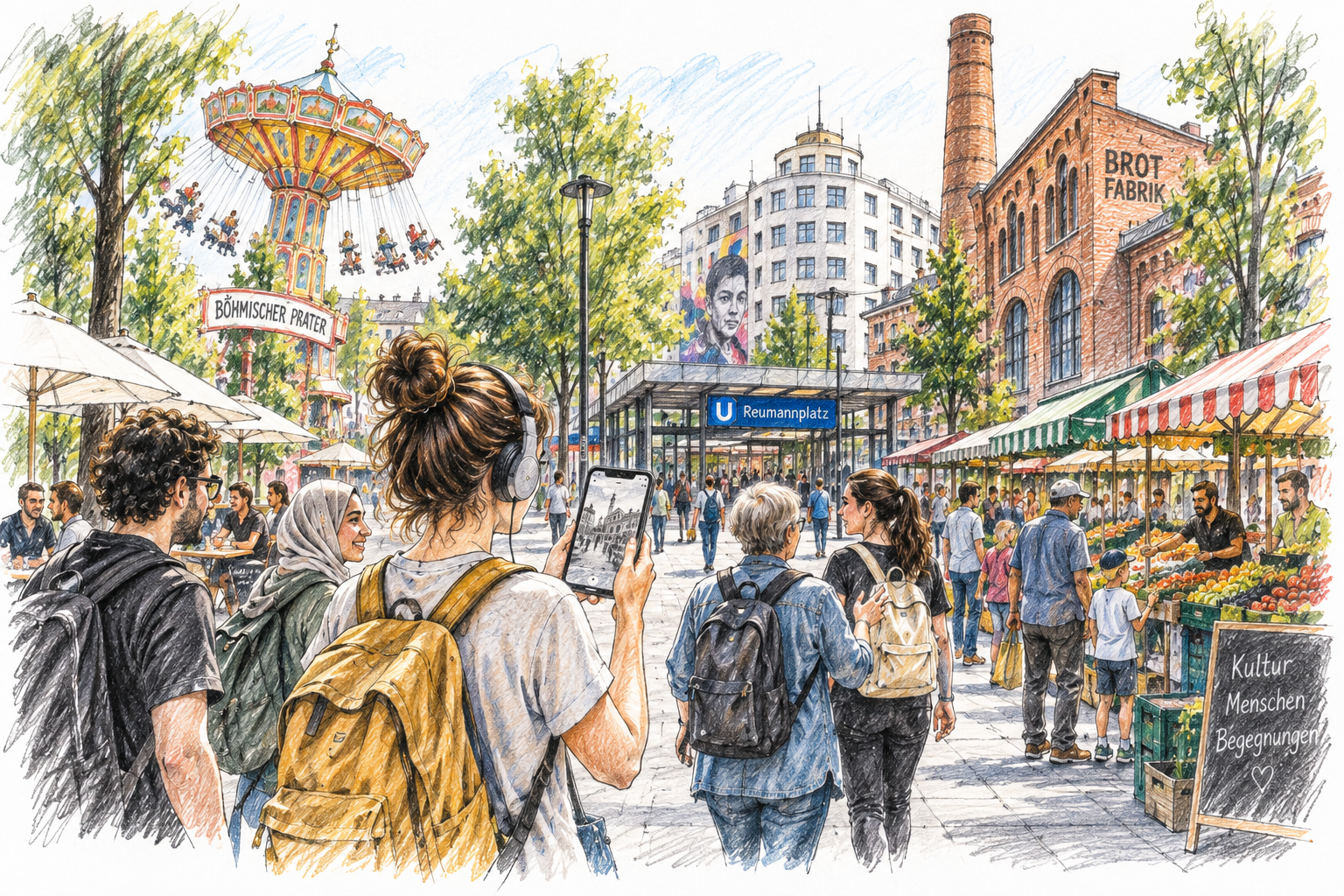
Favoriten is not a neighbourhood that can be explained by one landmark. There is Reumannplatz, where people shop, meet or simply pass through, with the Viktor-Adler-Markt nearby. Quellenstraße runs through part of the district, while an old bread factory in Absberggasse has become a cultural venue.
Favoriten even has another Prater of its own. The Böhmischer Prater, or Bohemian Prater, lies on the Laaer Berg. It is much smaller than Vienna’s world-famous Prater and has a history all of its own. During the festival, showpeople, regular visitors and witnesses from different generations tell stories about the place. It is not only about carousels and Ferris wheels, but also about workers from Bohemia and Moravia who came to Vienna and laboured in the brickworks under extremely harsh conditions. Anyone who has known Vienna mainly through the Hofburg, City Hall, Schönbrunn and the big Prater may find themselves asking: Why did I never know about this?
Three walks – and your phone comes too
One distinctive feature of FAVORITE FALL is the [AR]TWALKs. You do not need a guidebook or even an app: a smartphone and headphones are enough. The walks combine journalistic research, art and augmented reality. During the festival week, all three routes are available at the same time for the first time. They can be explored free of charge alone, with friends or with family, while anyone who wants to try out the technology first can join a short introduction at the cultural venue Das LOT.
One route runs through Innerfavoriten, from Reumannplatz via Viktor-Adler-Markt and Quellenstraße to the Brotfabrik. Along the way, visitors encounter hip-hop from municipal housing, opera singing from a local pub and performances in an underpass. Young people talk about their surroundings, while residents and workers tell stories from everyday life.
The second route leads to the Böhmischer Prater, while the third explores the Brotfabrik. This building tells no harmless industrial story. The former Ankerbrotfabrik is more than 130 years old. Witnesses and former employees share memories of the site, while the walk also addresses “Aryanisation”, expropriation and displacement under the Nazi regime. Music, theatre and other artistic forms make this history tangible along the way.
Here, the smartphone is not meant to block out the surroundings. It is meant to help people look more closely.
And then you simply join the walk
Alongside the digital walks are traditional Grätzltouren, guided neighbourhood tours. In Vienna, “Grätzl” is the everyday word for a manageable local neighbourhood, a small area within the wider city.
On one tour, Tamara leads visitors from the neighbourhood management office on Quellenstraße to several cultural venues and eventually across Reumannplatz. Participants get an insight into projects shaping the district’s cultural life, and the tour even ends with an ice cream at the famous Tichy. The walk is offered in German, English and BCS — Bosnian, Croatian and Serbian.
Another route begins at Central European University and leads via Gellertplatz and Viktor-Adler-Markt to a building housing artists’ studios. The focus is not on classic tourist sights, but on places, stories and personal perspectives from people shaping Favoriten today. Gradually, another picture of Vienna emerges: not simply a city whose important buildings are already marked in every guidebook, but a district where people live, work, argue, make music, preserve memories and create new places.
Who decides how a district is seen?
That question also runs through this year’s festival motto: “How to unite in dividing times”. On the opening day, 21 September, the subject is already being discussed at Reumannplatz. The Public Polis Process begins with a short theatre scene based on an everyday situation. Audience members can intervene, change what happens and even step onto the stage themselves.
Afterwards, five chairs stand around a round table, with two places open to members of the audience. The first discussion focuses on diversity, racism and stereotypes in public space. The conversation is mainly in German, but contributions in other languages are expressly welcome.
Elsewhere, the festival also experiments with how people perceive one another. In the music-theatre laboratory “Dialoge über Weltsysteme”, deaf and hearing artists work together, with sound, sign language, images and movement intended to play equal roles in the performance.
A map full of culture
There is another new feature in 2026: the FAVORITE_MAP. For the first time, the festival is mapping Favoriten’s cultural landscape, including the three digital walks.
Perhaps that map is a fitting image for the festival as a whole. On a conventional map of Vienna, St Stephen’s Cathedral, the Hofburg and Schönbrunn Palace are hard to miss. FAVORITE FALL adds other points: an old bread factory, a market, a small amusement park, an artists’ studio, a youth centre and a stage on a public square. None of them has to be more important than the famous landmarks, but together they tell the story of a Vienna that is easy to miss on a first visit. And you do not even have to travel far to find it: if you arrive at Vienna Central Station, you are practically already at its door.