Science on the Move
LEDs, smartphones, GPS: shortly after getting up, you have probably already encountered the results of quantum physics. In Donostia, this science is now setting off on a journey of its own.
You get up in the morning and switch on the light. Perhaps LEDs are shining above you. You look at your smartphone. Later, its navigation system shows you where you are.
None of this feels particularly mysterious. And yet, shortly after getting up, you have probably already encountered the results of quantum physics several times. LEDs and lasers, semiconductors in computers and smartphones, solar cells, MRI scanners in hospitals and the atomic clocks essential for GPS: many technologies in everyday life would not be possible without discoveries in quantum physics.
What will I ever need this for?
It is a question almost every physics teacher probably knows. With quantum physics, the answer is surprising: you do not have to wait until later. Some of its results have long been part of your everyday life.
The story began, however, with questions that sounded nothing like smartphones or GPS. At the beginning of the 20th century, Albert Einstein investigated how light interacts with matter. He later received the Nobel Prize for his explanation of the photoelectric effect – not for the theory of relativity for which he is far more famous today.
A little later, Werner Heisenberg was among the researchers describing an even stranger world. At the level of atoms and tiny particles, rules apply that contradict our everyday experience. A particle's position and momentum, for example, cannot both be determined with unlimited precision at the same time.
Back then, nobody could pull a smartphone from a pocket. There was no GPS, LEDs did not light people's homes and nobody underwent an MRI scan. Today, many technologies whose foundations grew out of this research seem completely ordinary.
So what comes next?
That may be the more exciting question. Quantum physics did not end with smartphones, lasers and atomic clocks. Researchers are now working on quantum computers, extremely sensitive quantum sensors and new ways of transmitting information using quantum properties.
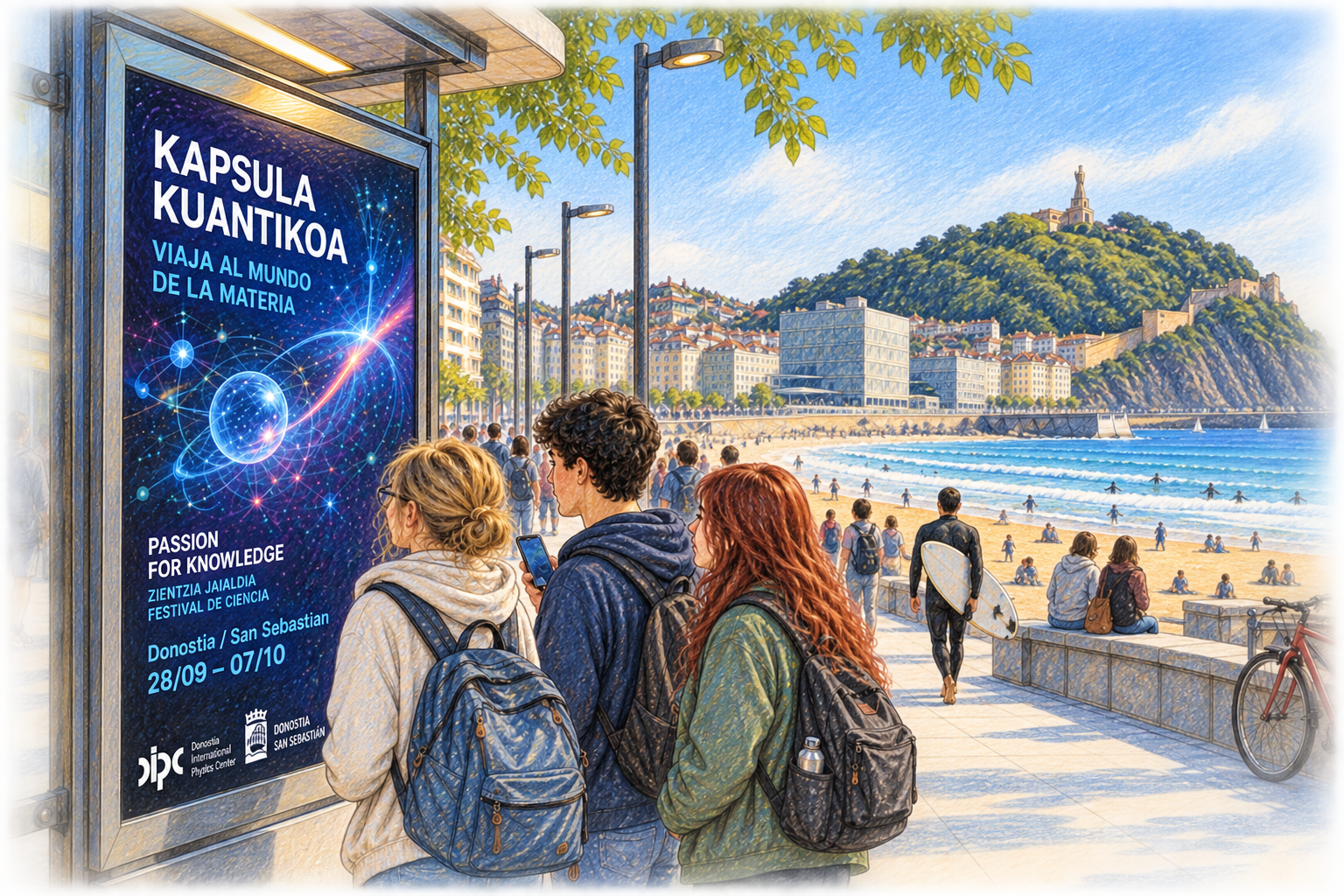
From 2 October in Donostia-San Sebastián, visitors can explore where that journey might lead. At the Passion for Knowledge science festival, the Kapsula Kuantikoa, or Quantum Capsule, opens its doors. Through audiovisual resources and interactive installations, visitors are invited to discover some basic principles of quantum physics and how quantum technologies appear in everyday life.
Groups can book visits lasting around 50 minutes, while open visits also allow people to explore the exhibition independently. The organisers do not reveal in detail on their website exactly which experiments and installations await inside. Perhaps that is not such a bad thing.
Physics comes to you
On 2 October, the Quantum Capsule will first stand beside the new Donostia International Physics Center building on the Ibaeta campus, in the heart of the so-called Quantum Mile. On 3, 6 and 7 October, it moves to the Sagüés esplanade.
Then something happens that makes “Science on the Move” quite literal: the capsule continues its journey, not merely to a few large university cities but through 147 municipalities across the Basque Country.
We usually imagine science the other way around. If you want to learn about quantum physics, you go to a university, a research centre or perhaps a science museum. Here, science itself sets out to meet people where they live.
And perhaps the capsule will answer another question along the way. Not only “What will I ever need this for?” but, for some visitors, perhaps also: “Could I research something like this myself one day?”
What still sounds like the future today
Around a century ago, physicists were studying a world whose rules seemed strange even to them. Over many decades, that fundamental research produced knowledge without which many technologies in our everyday lives would be difficult to imagine today.
What still sounds futuristic inside a research centre today may be perfectly ordinary to the next generation. Perhaps one day it will be inside a device people use every morning without giving quantum physics a thought.
Just like a smartphone today. Or an LED. Or that little blue dot on a map that knows remarkably well where you are – because high above you, atomic clocks aboard satellites are measuring time.