Where Does the Sacred Begin?
Twenty-four artists, a Reformed church and very different life stories: an exhibition in Sibiu asks how contemporary art can approach the sacred.
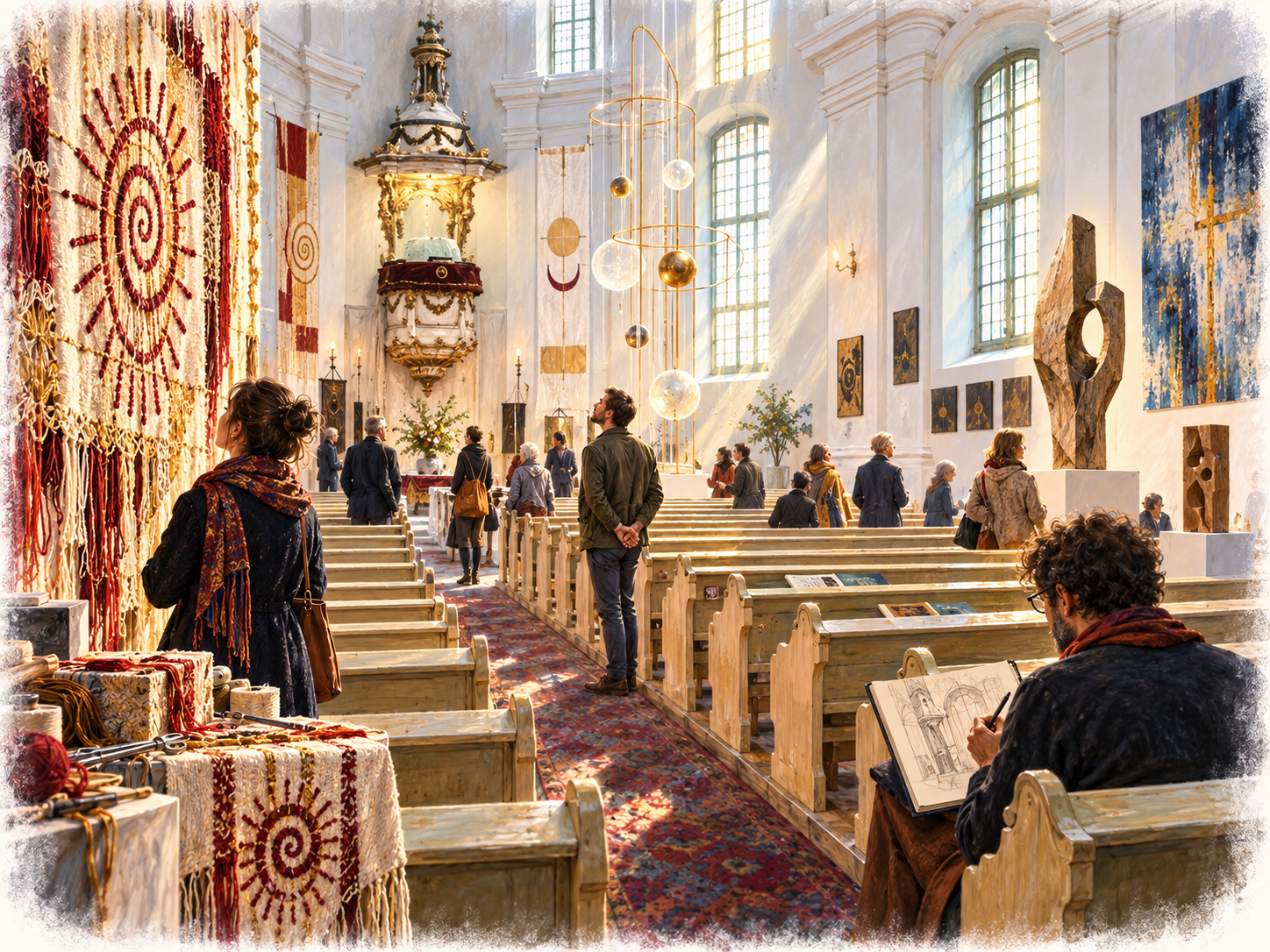
One artist works with threads and textiles. Another studied not only painting but theology as well. A sculptor has belonged to a British professional association for years. An artist born in Sibiu went to Düsseldorf to study. And one of the participants is an honorary citizen of the city.
On 15 September, their works come together in Sibiu’s Reformed-Calvinist church. As part of the Ars SACRA festival, the exhibition “Sacralitate în arta contemporană” – “The Sacred in Contemporary Art” opens there. Twenty-four artists from nine Romanian cities are taking part with painting, sculpture, graphic art, textile art and installations.
This is not simply about depicting crosses, churches or saints. The exhibition asks much broader questions: can light, memory or vulnerability become sacred? Can a door mean more than an entrance? Where is the boundary between what we can see and what we can only sense?
Speaking about the invisible with threads
Zoe Vida Porumb is one of the best-known names in the exhibition. In 2023, Romania’s National Museum of Art devoted a major retrospective to her, showing more than 140 works from five decades. Her art is created not primarily with brush and paint, but through textiles: tapestries, embroidery and other works made from fibres and fabric.
Religious subjects are nothing new in her work. Her series include depictions of the Annunciation and angels, alongside motifs from the culture of Maramureș and very old forms such as spirals and solar symbols. Christian imagery, regional tradition and signs handed down over centuries can meet in the same work.
That matters for the exhibition in Sibiu. Here, the sacred does not appear only as something belonging to a particular religion. It can also exist in a material, a memory or a sign passed down from one generation to the next.
A painter searching for the fourth dimension
With Xántus Géza, the connection between art and religion becomes even more direct. He studied art, completed a degree in theology at Budapest’s Péter Pázmány Catholic University in 1995 and later studied painting at the Accademia di Belle Arti in Rome. The Art Museum in Cluj-Napoca and the Brukenthal Museum in Sibiu have already devoted solo exhibitions to his work.
Xántus speaks of searching in his paintings for a “fourth”, transcendent dimension – something beyond the three spatial dimensions we perceive directly. His work explores light, permeability and the idea that the visible world is not everything.
His art has also taken an unusual journey: when Pope Francis visited Șumuleu Ciuc in Transylvania in 2019, he was presented with a painting by Xántus.
From Sibiu to Düsseldorf – and back
Ion-Ilarion Isăilă followed a very different path. Born in Sibiu, he first studied in Romania and then came to Germany on a DAAD scholarship. At the Düsseldorf Art Academy he worked with, among others, A. R. Penck and David Rabinowitch, and became a master student. He later lived and worked between Germany and France, and his works entered a number of museum and exhibition collections.
Now his name appears again in his home city, alongside artists whose biographies took very different directions. That is precisely what makes the exhibition interesting: there is no shared life story, and probably no single shared idea of what “sacred” means either.
Stone, wood – and very big questions
Eugen Petri brings yet another artistic language. He is a sculptor, studied at the Art Academy in Bucharest and has been a member of Britain’s Royal Society of Sculptors since 2007. His work has been shown in London, Germany, Italy and the United States, among other places.
So in Sibiu, textiles meet sculpture, painting meets graphic art, and artists with theological training meet others whose paths have led through Düsseldorf, London and elsewhere in Europe. At the same time, the exhibition remains firmly connected to the city. Ștefan Orth, himself a participating artist and one of the curators, has been an honorary citizen of Sibiu since 2010.
And all of this takes place not in a neutral white museum space but in a church. The location therefore becomes part of the exhibition too: architecture, light, history and religious meaning are already present before the first artwork is installed.
Do you have to believe to find something sacred?
A religious person may recognise something sacred in a cross. Someone else may find that feeling in an old object, in music, in a place, in nature or in the memory of another person. And an artist can try to make visible something for which there may be no single, clear image at all.
The exhibition in Sibiu does not offer one answer. It places 24 different attempts side by side.
The sacred begins where an object suddenly comes to mean more to someone than only what can be seen.