Between Romania and Ukraine: Horești shows how Moldova keeps its traditions alive
The Republic of Moldova is small, yet remarkably diverse in culture and language. At the Tezaur Național festival this weekend, music, traditional dress, crafts and food come together – showing how traditions can be passed on when they are no longer an everyday necessity.
Look at the map of Europe between Romania and Ukraine and you will find a country that is easy to overlook. The Republic of Moldova has around 2.4 million inhabitants. Its history has moved through different political and cultural worlds – and that can still be heard today.
In the 2024 census, almost 80 per cent of the population identified Romanian or “Moldovan” as their mother tongue. Russian, Gagauz, Ukrainian and Bulgarian are also part of the country's linguistic landscape. Russian is understood by considerably more people than the number who identify it as their mother tongue would suggest. Moldova is therefore not a culturally uniform patch of land between two larger neighbours, but a small European crossroads.
Today, part of this cultural history becomes visible in Horești, around 25 kilometres south of Chișinău. On 22 and 23 August, the village hosts the sixth edition of the Tezaur Național festival. From 11 a.m., the Peatihatca area is filled with music, dance, crafts and traditional food. Admission is free.
What remains when we no longer need it?
A handwoven blanket no longer has to keep a house warm. Clothes are no longer embroidered by hand because there is no alternative. And people no longer have to gather together on winter evenings to work while exchanging stories and songs.
Yet all of these things can continue to live.
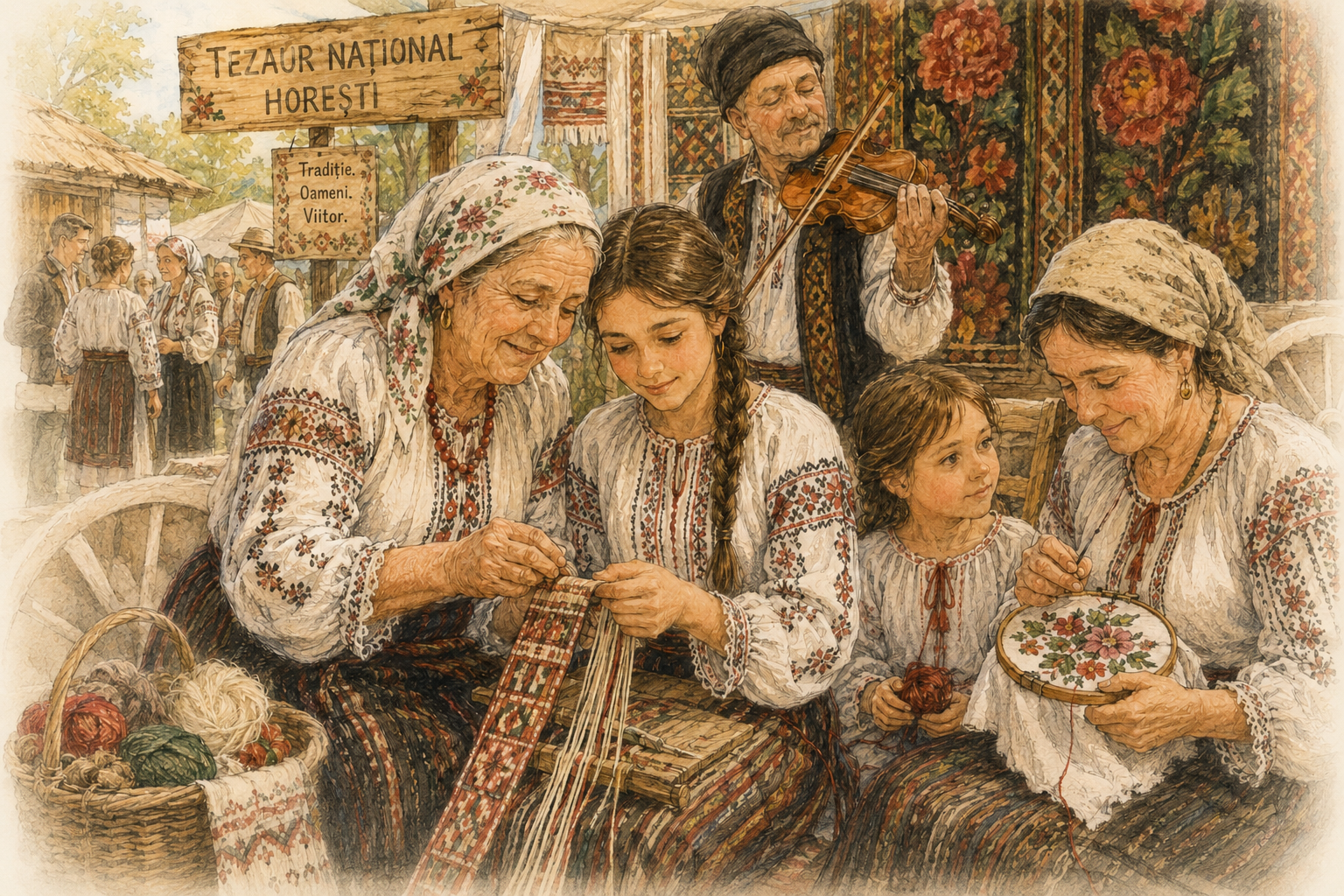
At Tezaur Național, handwoven carpets are displayed, craftspeople demonstrate their skills, and children and adults can try the techniques themselves in workshops. The Parada Portului Popular puts traditional clothing back into motion: instead of simply being displayed, it is worn while music and dance ensembles from different parts of the country perform.
A room for important things
The festival also includes the Casa Mare and Ograda Țărănească areas.
The Casa Mare, the “great room”, held a special place in traditional Moldovan homes. Guests were received there and valuable textiles, carpets and other possessions were kept there. The Ograda Țărănească, the peasant courtyard, extends this picture to life outside the house.
At the festival, such spaces are not simply reconstructed as scenery. They provide a setting for objects and crafts that were once a natural part of everyday life.
Sitting together, working – and telling stories
One particularly interesting element is the large Șezătoare Națională. Traditionally, a șezătoare was a communal gathering, especially during long autumn and winter evenings. People spun, sewed or carried out other work while stories were told, songs were sung and music was played.
At the festival, this old form of gathering becomes a place where traditional skills are practised together once again. Their purpose has changed: what was once done out of necessity is now consciously passed on.
Food is part of this story too. Cooking demonstrations present traditional dishes, while local producers offer their products. Music, clothing, crafts and food therefore do not stand beside one another like separate museum exhibits. They come together again where culture originally emerged: between people.
Perhaps that matters particularly in a country such as Moldova.
Cultural identity there has to coexist with different historical experiences, languages and regional traditions. One festival cannot explain all of that diversity, nor can it represent every part of the country. But it can show how cultural knowledge is passed on.
A carpet can survive for centuries in a museum. A melody can be recorded. A recipe can be written down.
Culture becomes alive again when somebody says: show me how to do that.
Today, 23 August, Horești once again shows how culture is passed on: one person demonstrates – and another says, show me how to do that.